
Most electrical concerns don’t start with sparks or outages. They start quietly. A bathroom outlet that trips inconsistently. A garage receptacle that seems fine but feels questionable. In those moments, uncertainty is the real problem. Somewhere between “it probably works” and calling an electrician, tools like the Klein Tools RT250 GFCI Outlet Tester exist to make electrical conditions visible, measured, and understandable.
This article looks at how the RT250 fits into everyday residential and light professional settings, focusing on how its design choices support confidence rather than urgency.
What a GFCI Outlet Tester Is Meant to Clarify
A GFCI Outlet Tester is not about diagnosing every possible electrical issue. Its role is narrower and more practical. It helps confirm whether a receptacle is wired correctly, operating as intended, and responding within expected parameters when protection is required. That focus matters, especially in homes where GFCI outlets are common but rarely examined unless something feels off.
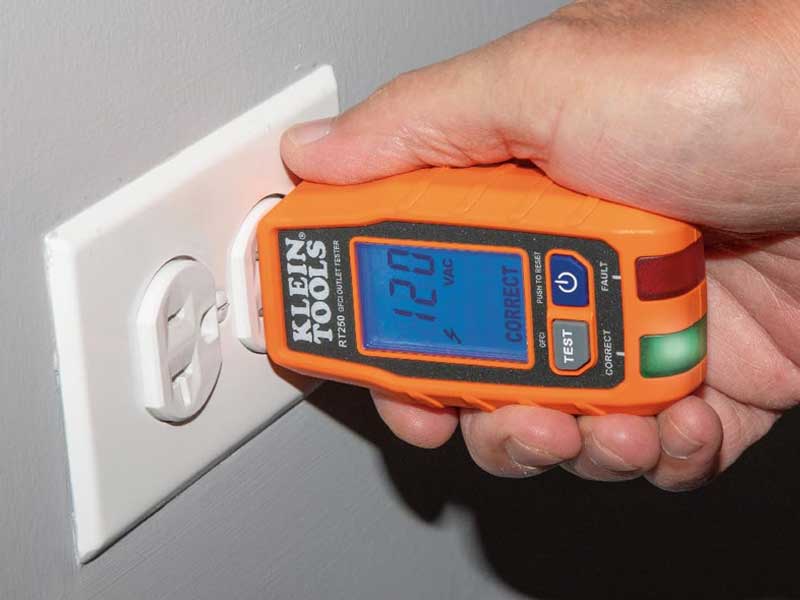
The RT250 approaches this role with an emphasis on visibility. Instead of relying solely on indicator lights, it provides a large, backlit LCD that displays voltage readings clearly. This immediate readout answers a basic but essential question: is power present, and at what level. For anyone checking GFCI outlet behavior, that information sets the foundation for everything that follows.
Beyond voltage presence, the tester identifies common wiring conditions. Correct wiring, reversed connections, and fault states are communicated through both the LCD and LED indicators. This dual-layer feedback reduces interpretation errors, particularly in spaces where lighting is poor or outlets are awkwardly placed.
The goal isn’t to overwhelm the user with data. It’s to reduce ambiguity. By showing what’s happening rather than asking the user to infer it, the RT250 supports calmer, more deliberate decisions about next steps.
Understanding Trip Time and Why It Matters
One of the RT250’s distinguishing features is its ability to display GFCI trip time directly on the LCD. This detail may seem minor, but it adds meaningful context. GFCI devices are designed to interrupt power quickly when imbalances occur. Seeing how long that interruption takes provides insight into whether the device is responding within expected limits.
Trip time visibility shifts evaluation from subjective to measurable. Instead of relying on a vague sense that a GFCI “feels slow” or “seems fine,” the tester provides a concrete reference. This can be especially useful in environments where multiple outlets are installed over time and may perform slightly differently.
For homeowners, this feature supports routine checks without escalating concern. For property managers or inspectors, it adds documentation-friendly clarity. The tester isn’t declaring something unsafe; it’s presenting timing data that can be interpreted calmly and accurately.
This measured approach aligns with modern electrical expectations. Protection devices should be verified, not assumed. Trip time display turns that verification into a straightforward observation rather than a guess.
Detecting Wiring Faults Without Guesswork
Electrical outlet testers often promise fault detection, but the value lies in how clearly those faults are communicated. The RT250 identifies common wiring issues that affect both safety and functionality, including open neutral and open ground conditions. These faults are not always visible or obvious, yet they can undermine the protective role of a GFCI outlet.
What stands out here is the patent-pending detection system for open neutral and open ground conditions. Instead of lumping these faults into generic error states, the tester differentiates them. That distinction matters because the implications and remedies differ. Clear identification prevents overreaction and supports informed follow-up.
This level of specificity also reduces false confidence. An outlet that appears to work but has an open ground can still present risks. By surfacing that condition explicitly, the tester reinforces the idea that functionality and correctness are not always the same.
For anyone using an outlet and GFCI tester as part of routine checks, this clarity turns electrical safety into something observable and manageable rather than abstract.
Visual Feedback That Matches Real Environments
LEDs That Confirm at a Glance
Bright green and red LEDs provide immediate visual cues about wiring conditions. In many cases, this is enough to understand the outlet’s status without focusing on the LCD. The colors are intuitive and visible even in peripheral vision, which is useful when testing multiple outlets in succession.
The LEDs don’t replace the screen. They complement it. Together, they create redundancy that reduces misinterpretation. If one signal is missed, the other reinforces the message.
LCD Readability in Context
The backlit LCD is designed for readability rather than decoration. Voltage numbers are clear, and wiring indications are legible without scrolling or menus. This matters in basements, garages, or outdoor-adjacent spaces where lighting conditions vary.
The display doesn’t attempt to be multifunctional. It focuses on the information relevant to outlet testing, keeping cognitive load low. That restraint supports consistent use and reduces hesitation.

Klein Tools RT250 GFCI Outlet Tester with LCD Display, Electric Voltage Tester for Standard 3-Wire 120V Electrical Receptacles
Available on Amazon
Auto-Hold for Practical Reach
Hard-to-reach outlets are common. Behind appliances, under sinks, or along exterior walls, visibility is often limited. The auto-hold feature captures the reading and holds it on the screen, allowing the user to pull the tester back into view without losing information.
This small convenience changes how the tool fits into real spaces. It adapts to the environment rather than forcing the environment to adapt to it.
Safety Rating as a Design Boundary
Electrical tools need clear limits. The RT250 carries a CAT II 135V safety rating, indicating it’s designed for testing standard 120V branch circuits commonly found in residential and light commercial settings. This rating defines appropriate use without overstating capability.
By staying within this boundary, the tester maintains reliability. It’s not positioned as an all-purpose electrical diagnostic device. It’s purpose-built for outlets and GFCI receptacles, where accuracy and safety expectations are well defined.
For users, this clarity supports trust. Knowing what a tool is designed to handle is as important as knowing what it can detect. The safety rating frames the RT250 as a focused electric voltage tester rather than a catch-all solution.
How This Fits Into Routine Electrical Awareness
Electrical systems are often invisible until something fails. Regular checks help surface issues early, but only if the process feels accessible. Tools that are confusing or overly technical tend to sit unused. The RT250’s design choices aim to avoid that outcome.
As an electrical outlet tester, it integrates easily into periodic inspections. Plug in. Observe. Interpret. The sequence is straightforward, and the feedback supports each step without pressure.
For homeowners, this supports a basic level of electrical literacy. For professionals, it provides consistency across multiple locations. In both cases, the tool encourages engagement rather than avoidance.
The inclusion of voltage readout also positions it alongside a klein tools voltage tester lineup that emphasizes clarity and reliability. It doesn’t compete with more advanced meters; it complements them by focusing on outlets specifically.
Evaluating Value Through Design Logic
Value in testing tools often comes from coherence. Features should support a clear purpose rather than accumulate for marketing appeal. The RT250’s combination of LCD display, LED indicators, fault detection, and trip time measurement aligns around one goal: making outlet conditions understandable.
Compared to simpler testers that rely only on lights, the added screen provides depth without complexity. Compared to more advanced meters, it remains approachable and quick to deploy. This balance places it comfortably in the middle ground, where most users operate.
For those comparing options labeled as the best voltage tester for home outlets, this device stands out by narrowing its scope. It doesn’t try to be everything. It tries to be clear.
Limitations as Part of the Picture
No outlet tester replaces a full electrical inspection or addresses every wiring scenario. The RT250 is designed for standard three-wire 120V receptacles. It won’t diagnose issues beyond that context, and it doesn’t attempt to.
Understanding this limitation reframes expectations. The tester is a screening and verification tool. It identifies common issues and confirms protective behavior. When results fall outside expectations, it signals that further evaluation may be appropriate.
This transparency supports calm decision-making. Instead of presenting results as final judgments, the tester provides information that fits into a broader safety mindset.
Where This Tool Makes the Most Sense
The RT250 is well suited for homes with multiple GFCI outlets, rental properties where periodic checks are routine, and light commercial spaces where consistency matters. It’s also useful for anyone who wants more insight than a basic outlet gfci tester provides, without stepping into professional-only equipment.
Its portability and simplicity mean it’s likely to be used rather than forgotten. That practical reality often determines whether safety tools actually improve outcomes.
A Measured Approach to Electrical Confidence
Electrical safety benefits from tools that inform rather than alarm. By combining clear visual feedback, specific fault detection, and contextual data like trip time, the Klein Tools RT250 supports a thoughtful approach to outlet testing.
It doesn’t promise certainty in every situation. It offers clarity where clarity is possible. That distinction makes it a reliable companion for maintaining awareness in everyday electrical environments, quietly reinforcing confidence without demanding attention.
Klein Tools RT250 GFCI Outlet Tester with LCD Display, Electric Voltage Tester for Standard 3-Wire 120V Electrical Receptacles
Available on Amazon

Alejandro focuses on everyday home safety practices and the tools that support them. With years of experience observing how common household risks develop, he writes about practical ways to reduce hazards related to fire, electricity, and water damage. His approach emphasizes clarity, usefulness, and solutions that fit naturally into real homes.