
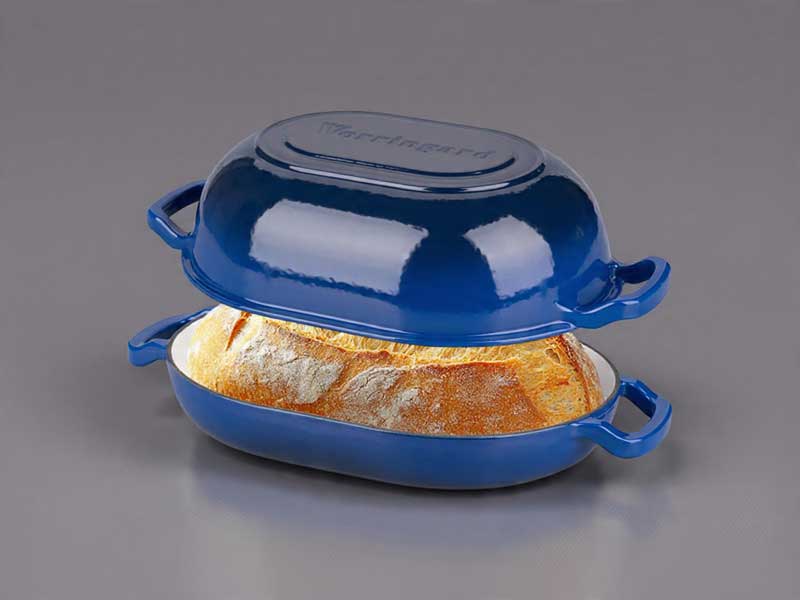
Bread baking often gets framed as an art that depends on intuition and luck, when in reality, it depends more on predictable heat behavior and controlled moisture. Tools that promise dramatic results frequently focus on aesthetics or novelty. The VORRINGARD enameled cast iron Dutch oven enters the conversation more quietly, positioning itself around thermal consistency and broad kitchen utility rather than spectacle.
For cooks who value repeatable outcomes, especially when working with sourdough or structured sandwich loaves, this type of enameled cast iron Dutch oven addresses a practical question: whether a single vessel can support steady bread results while still earning its space during everyday cooking.
Why Thermal Stability Matters in an Enameled Cast Iron Dutch Oven
Successful bread baking depends on how heat moves, not how hot an oven dial reads. An enameled cast iron Dutch oven functions as a buffer between the oven’s fluctuations and the dough’s needs. The heavy construction absorbs heat slowly, then releases it evenly, helping dough expand at a controlled rate.
This is particularly relevant for sourdough bread baking, where early oven spring shapes the loaf’s structure. Cast iron’s mass limits sharp temperature drops when the lid is removed or when the oven cycles. The VORRINGARD enameled cast iron Dutch oven uses this basic principle effectively, focusing on weight and wall thickness rather than design complexity.
In practical terms, that stability supports:
- Even crust development without localized scorching
- A soft, fully cooked interior that finishes at the same pace as the exterior
- Reduced need to compensate with oven adjustments mid-bake
These are not premium-only benefits. They are baseline expectations for any heavy-duty cast iron cookware designed for baking.
Bread Performance Without Specialized Complexity
The misconception around bread ovens is that shape or branding determines success. In reality, internal volume, lid fit, and heat retention matter more. This bread oven’s round profile and close-fitting lid create a contained baking environment that supports moisture retention during the critical early phase of baking.
Lid Design and Steam Retention
Steam plays a role in crust formation by delaying surface setting, allowing the loaf to expand. A well-fitted lid traps the dough’s natural moisture without additional tools. The VORRINGARD cast iron bread pan relies on this straightforward interaction rather than vents or removable inserts.
This approach favors:
- Consistency over customization
- Simpler workflow for home bakers
- Fewer variables to manage during baking
While highly specialized bread cloches exist, they often limit versatility. Here, the lid supports bread baking while remaining useful for braising and slow cooking.
Interior Space and Dough Expansion
At 7 quarts, the interior volume provides room for dough to rise without crowding. This matters for sourdough loaves with strong oven spring, where vertical expansion can become restricted in shallower vessels. The depth allows expansion without forcing the dough to spread outward too early, which can flatten structure.
This balance between width and depth also suits sandwich loaves baked in free-form or lightly shaped styles, giving home bakers flexibility without shifting tools.
Workflow Versatility Beyond Bread Baking
A Dutch oven that only performs one task disrupts kitchen rhythm. The VORRINGARD enameled cast iron Dutch oven extends beyond bread into daily cooking scenarios without adjustment or compromise.
It is compatible with gas, electric, ceramic, and induction cooktops, moving directly from stovetop to oven and back to the table. That compatibility supports a continuous workflow, which is often overlooked in home kitchens.
Common uses that align with its design include:
- Slow-cooked stews and braises that benefit from even heat
- Simmering soups without hot spots
- Oven roasting where stable temperatures matter
- Boiling or blanching in a vessel that retains heat after the burner is reduced
This breadth of use is not about novelty. It reflects the core advantage of enameled cast iron cookware: thermal predictability across cooking methods.

VORRINGARD Enameled Cast Iron Sourdough Bread Oven, Dutch Oven, Loaf Cast Iron Bread Pan for Homemade Bread Baking
Available on Amazon
Heat Distribution and Energy Efficiency in Heavy-Duty Cast Iron Cookware
Heavy-duty cast iron cookware often gets criticized for long preheat times, but that characteristic supports energy efficiency once cooking begins. The VORRINGARD enameled cast iron Dutch oven holds heat effectively, reducing the need for constant burner adjustments.
Looped handles contribute more than aesthetics. They support balanced lifting and repositioning, particularly when the pot is full. In professional settings, awkward handle placement slows movement and increases risk. At home, it affects confidence and ease of use.
The round shape encourages even circulation of heat and liquids, which matters during simmering and braising. Corners, while useful in some cookware, can trap heat unevenly. The round interior minimizes that issue, keeping temperatures consistent along the walls and base.
Surface Finish and Practical Maintenance Expectations
Enamel coating changes how cast iron fits into daily cooking. It eliminates seasoning routines while introducing basic care standards. The VORRINGARD enameled cast iron Dutch oven is designed for warm soapy water cleaning and thorough drying, without abrasive pads or metal utensils.
This maintenance approach suits cooks who want cast iron performance without long-term upkeep rituals. It also supports use with acidic ingredients, which uncoated cast iron can struggle with over time.
That said, enamel demands respect:
- Metal utensils can damage the coating
- Sudden temperature changes should be avoided
- Storage should allow airflow to prevent moisture retention
These are standard trade-offs, not design flaws. They reflect how enamel behaves under regular use.
Size, Dimensions, and Kitchen Fit
With dimensions of 15.7 by 5.9 inches, this Dutch oven occupies a familiar footprint for a 7-quart vessel. It is large enough for family-sized meals and full loaves, yet still manageable on standard home stovetops.
The size supports batch cooking without crossing into commercial-scale bulk. That distinction matters for storage, cleaning, and daily handling. Oversized cookware often gets sidelined simply because it disrupts normal kitchen flow.
For gifting, the proportions and neutral blue enamel present well without feeling ornamental. Housewarmings, weddings, and milestone birthdays often benefit from tools that serve practical roles long after presentation.
Understanding Trade-Offs in a Cast Iron Bread Oven
No tool excels at everything. The weight that supports heat retention also requires intentional handling. This Dutch oven is not designed for quick, one-handed movement or rapid temperature shifts.
The enamel finish favors careful utensil selection and gentle cleaning. Cooks who prefer metal tools may need to adjust habits slightly. In return, they gain easier cleanup and broader recipe compatibility.
These compromises are inherent to enameled cast iron cookware. The value comes from recognizing whether those trade-offs align with daily cooking patterns.
Where This Dutch Oven Fits Best in a Home Kitchen
The VORRINGARD enameled cast iron Dutch oven suits cooks who prioritize consistency over experimentation. It works well for those baking sourdough regularly, preparing structured loaves, or relying on slow-cooked meals that benefit from stable heat.
It does not attempt to replace specialty pans or lightweight pots. Instead, it fills the role of a reliable anchor piece, supporting a wide range of recipes without demanding constant attention.
In kitchens where workflow matters, tools that behave predictably tend to get used more often. This Dutch oven aligns with that expectation, focusing on fundamentals rather than performance theatrics.
A Measured Perspective on Long-Term Use
The VORRINGARD enameled cast iron Dutch oven is best understood as a consistency tool rather than a specialty statement piece. Its heat retention, enclosed baking environment, and broad stovetop-to-oven compatibility support reliable bread results while remaining useful for everyday braising, simmering, and roasting. The weight and enamel care requirements are expected trade-offs for cast iron at this scale, not drawbacks. For cooks who want an enameled cast iron Dutch oven that behaves predictably across repeated use—especially when baking sourdough or structured loaves—this model fits cleanly into a steady, well-organized kitchen workflow.
VORRINGARD Enameled Cast Iron Sourdough Bread Oven, Dutch Oven, Loaf Cast Iron Bread Pan for Homemade Bread Baking
Available on Amazon

Emily trained in culinary school and worked in several fast-paced restaurant kitchens before shifting into product testing. She understands how cookware, knives, and prep tools should perform under pressure. Emily’s reviews blend professional cooking standards with relatable insights for home chefs looking to upgrade their daily tools.