
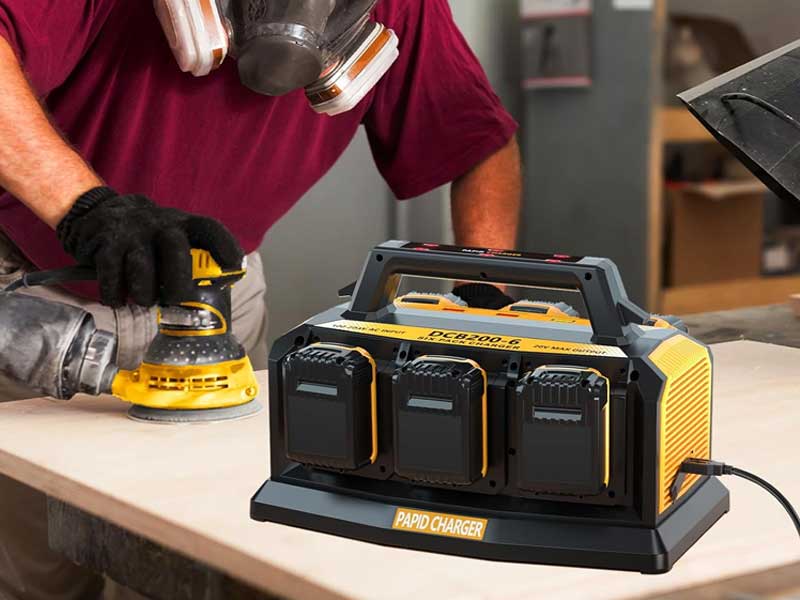
If you’re new to cordless tools or slowly building a Dewalt lineup, battery charging can feel more complicated than it should. Between 12V, 20V, and 60V packs, single-port chargers, and different charge speeds, it’s easy to wonder whether upgrading your charging setup will actually make projects smoother or simply add clutter. A multi-port option like a Dewalt 20V fast charger often enters the picture right at that moment of uncertainty, when efficiency starts to matter more than keeping things minimal.
The Fast Charger for Dewalt 20V Battery with a 6-port simultaneous charging design aims to reduce that friction by handling several batteries at once while keeping compatibility straightforward. Understanding how this charger works, and where its design choices matter for typical DIY users, helps clarify whether it’s a practical upgrade or just a convenience feature.
Why a Dewalt 20V fast charger changes how battery rotation works
Cordless tools rely on a simple rhythm: use a battery, recharge it, repeat. With a single-port charger, that rhythm becomes linear, which can slow down momentum during longer projects. A Dewalt 20V fast charger with six independent ports shifts that pattern into parallel charging, allowing multiple batteries to recover at the same time.
This charger delivers up to 3 amps per port, which is an important detail. Many multi-battery stations divide power unevenly, slowing charge times as more packs are added. Here, each slot maintains its own output, so charging one battery does not reduce performance for the others. For DIY users juggling drills, impact drivers, saws, and outdoor tools, that consistency keeps battery rotation predictable.
From a practical standpoint, this means:
- Fewer pauses to wait for a single battery to finish charging
- More flexibility to grab any charged pack without planning ahead
- Better alignment with weekend projects that stretch over several hours
The result is not about speed alone, but about smoother workflow management, especially when multiple tools share the same battery platform.
How the six-port charging design distributes power safely
Independent charging channels explained
Each charging port functions as its own channel, with internal circuitry monitoring voltage, current, and temperature for the battery inserted. This matters because Dewalt batteries vary in capacity and chemistry between 12V, 20V, and 60V FlexVolt designs.
Rather than treating all batteries the same, the charger’s internal logic adjusts power delivery per port. That approach reduces stress on smaller packs while still delivering efficient charging to higher-capacity batteries. For beginners, this design removes the need to match batteries to specific slots or worry about mixing voltages.
Why 3A output per port is a balanced choice
A 3-amp output sits in a middle ground between slow trickle charging and aggressive rapid charging. Higher amperage can shorten charge times but increases heat, which affects long-term battery health. This charger prioritizes consistency and battery preservation, which aligns well with home users who want tools to last across years of projects.
For most Dewalt 20V batteries, a 3A charge rate restores usable capacity quickly without excessive thermal buildup. That balance supports repeated charging cycles without accelerating wear.
Compatibility across Dewalt 12V, 20V, and 60V systems
One common hesitation around aftermarket chargers is compatibility. Dewalt’s ecosystem includes multiple battery formats, and switching between chargers can feel risky. This charging station is designed to work seamlessly with Dewalt 12V, 20V, and 60V FlexVolt batteries, covering models from DCB200 through DCB615.
From a mechanical perspective, this compatibility relies on precise contact alignment and voltage detection. The charger recognizes the battery type once inserted and adjusts its charging profile automatically. That process happens internally, without requiring user input or configuration.
It also replaces several official Dewalt chargers, including DCB104, DCB112, DCB115, and DCB118. For DIY learners upgrading from entry-level kits, this consolidation reduces the number of chargers taking up wall outlets or bench space.
Compatibility here is less about brand loyalty and more about maintaining a consistent battery workflow across tools.
Understanding the smart protection system inside the charger
What the built-in smart chip actually does
Inside the charger is a control chip responsible for monitoring charging conditions in real time. It tracks:
- Overcharge risk by measuring voltage thresholds
- Overheat conditions through temperature sensors
- Overcurrent flow that could stress internal components
- Short-circuit detection to prevent electrical faults
These protections operate continuously, not only at startup. For users charging multiple batteries overnight or during long work sessions, this system provides stability without requiring supervision.
Why certifications matter for home workshops
The charger carries FCC, CE, and RoHS certifications, which indicate compliance with electrical safety, electromagnetic interference, and material restrictions. While certifications often sound abstract, they translate into predictable behavior when the charger is plugged into a typical home outlet alongside other tools and electronics.
For beginners setting up their first dedicated DIY space, that predictability reduces uncertainty around electrical safety and long-term reliability.
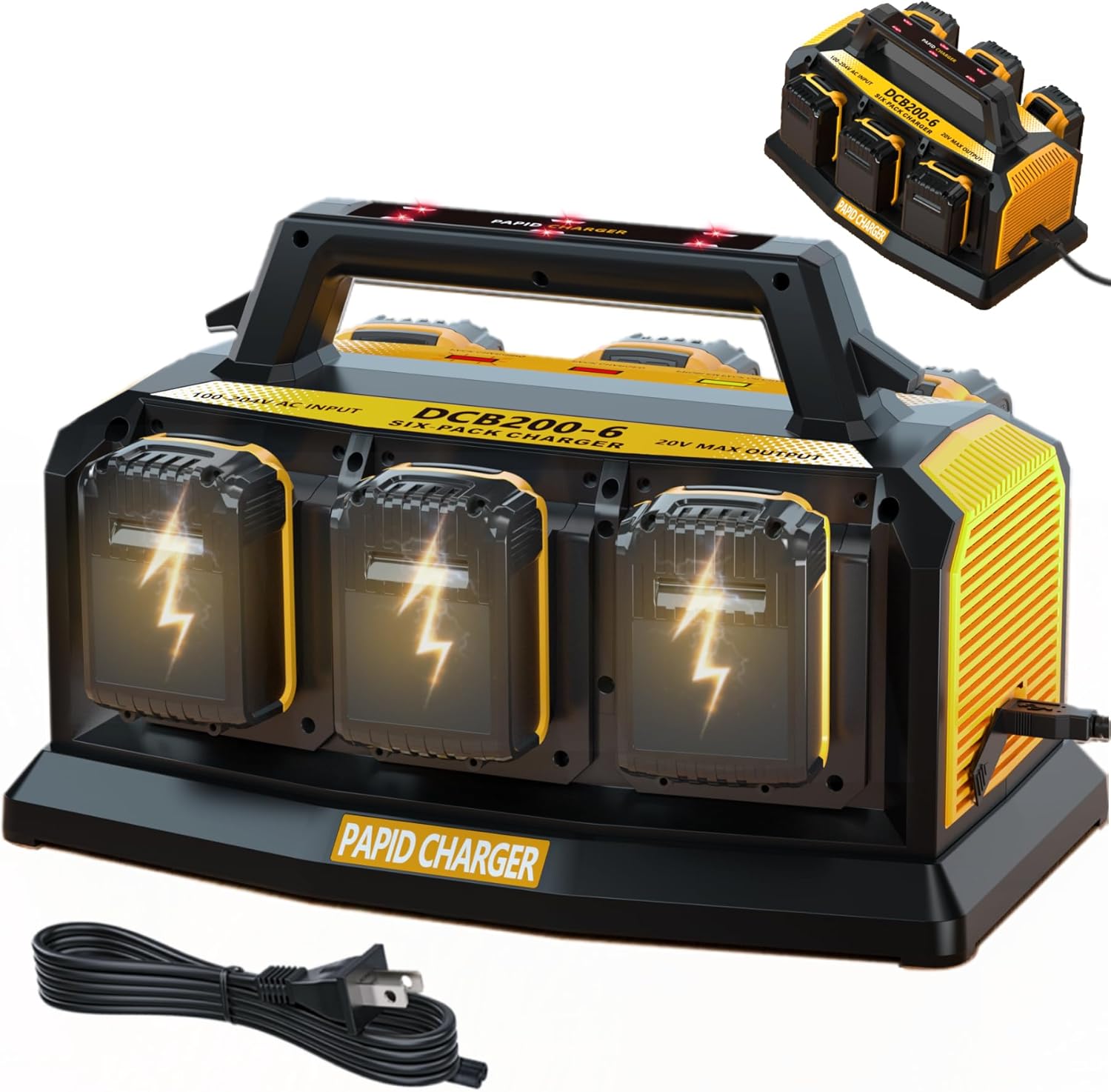
Fast Charger for Dewalt 20V Battery: 6-Port Multi Simultaneous Rapid Charger Station Compatible with Dewalt 60V Batteries
Available on Amazon
Visual feedback that simplifies battery management
Charging multiple batteries simultaneously creates a new challenge: knowing which ones are ready. This station addresses that with individual LED indicators for each port.
Each indicator communicates status clearly:
- Flashing red shows active charging
- Solid red indicates a fully charged battery
- Solid yellow signals a battery or charger error
Because each port has its own LED, there’s no need to remove batteries just to check progress. This detail seems small, but it helps users build an intuitive understanding of battery readiness, which supports smoother project planning.
For example, a DIYer can quickly scan the station and decide which batteries are ready for higher-demand tools like circular saws or outdoor equipment.
Build quality and aftermarket positioning
What “premium aftermarket” means in practical terms
This charger is not an original Dewalt product, and that distinction matters for transparency. Premium aftermarket design focuses on compatibility and performance while meeting safety standards, rather than branding.
In physical terms, this shows up in:
- Durable housing designed for repeated battery insertion
- Firm port tolerances that maintain electrical contact
- Stable base weight that prevents tipping when fully loaded
These choices support everyday use without feeling fragile or temporary.
Durability expectations for DIY environments
Home workshops vary widely, from clean garages to shared utility spaces. A charger designed for multiple batteries must tolerate occasional dust, vibration, and frequent handling. This station’s construction aligns with that reality, offering durability suitable for both casual DIY use and more frequent project cycles.
Evaluating value beyond raw charging speed
Charging speed often dominates discussions around battery chargers, but value includes more than minutes saved. A Dewalt 20V fast charger like this one earns its place through efficiency, organization, and system compatibility.
Key value considerations include:
- Reduced downtime across multiple tools
- Consolidation of chargers into one station
- Battery-friendly charging rates that support longevity
For users managing several Dewalt batteries, the station reduces friction across the entire workflow. That improvement compounds over time, especially as tool collections grow.
Who benefits most from this multi-port charging station
This charger suits DIY learners and confident home users who:
- Own multiple Dewalt 20V or FlexVolt tools
- Prefer organized charging over scattered single chargers
- Want clear feedback without technical setup
It may feel excessive for someone with one or two batteries, but once a tool lineup expands, the design logic becomes more apparent. The station supports growth without forcing users to rethink their battery strategy later.
Learning confidence through predictable tool readiness
Understanding how tools and accessories behave builds confidence. A charging station that behaves consistently teaches users to trust their setup. Batteries charge at expected rates, indicators communicate clearly, and compatibility remains stable across tool types.
That reliability reduces mental load, letting beginners focus on learning skills rather than managing equipment. Over time, that clarity supports better project planning and smoother execution.
In that context, a Dewalt 20V fast charger is not just a convenience upgrade. It becomes part of a learning-friendly system that encourages steady progress, informed decisions, and confidence built on understanding rather than trial and error.
Fast Charger for Dewalt 20V Battery: 6-Port Multi Simultaneous Rapid Charger Station Compatible with Dewalt 60V Batteries
Available on Amazon

Jenna is a mechanical engineering graduate who fell in love with weekend DIY projects during college. She enjoys analyzing how tools are built, how they perform, and whether they offer real value. Jenna writes in a friendly, accessible style that helps beginners feel confident tackling their first home upgrades.