
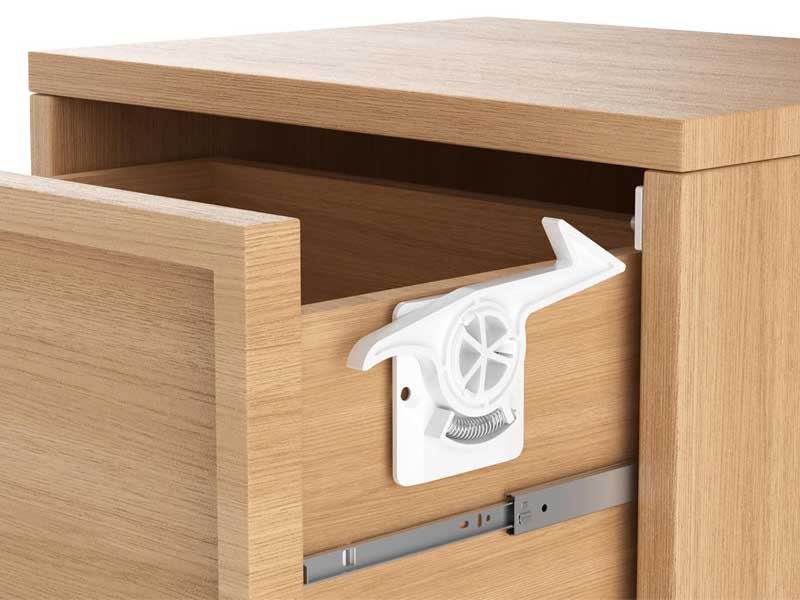
Drawers are rarely seen as hazards until a small hand figures out how easily they open. Kitchens, bathrooms, and dressers quietly hold sharp tools, chemicals, or heavy objects, all at a height that invites curiosity. Over time, many households realize that true drawer safety is not about locking everything down aggressively, but about setting calm boundaries that work without changing how adults use their space. That is the context in which the 6 Pack Child Safety Drawer Locks by THAULANG are designed to make sense.
Safety Drawer Locks work best when they disappear from daily thinking
The most effective Safety Drawer Locks do not remind you they exist. They simply prevent access where access creates risk. This design philosophy matters because families do not want to negotiate with safety systems every day. They want protection that stays in place, works consistently, and fades into the background.
THAULANG’s approach focuses on what happens at the exact moment a drawer is pulled. Once locked, the drawer opens with zero gap. There is no partial opening. No space for fingers. No opportunity for pets or children to reach inside. This eliminates a common weakness seen in many childproof drawer locks that allow limited access before stopping movement.
The zero-gap outcome changes how adults perceive the space. The drawer is either closed or unlocked intentionally. There is no gray area that invites testing or tugging.
Why zero-gap design changes the safety equation
Many cabinet childproof locks rely on flexible straps or interior latches. While effective in some situations, they often allow drawers to open slightly before stopping. That small opening may seem insignificant, but it can be enough for a child to grab something or strain the mechanism repeatedly.
THAULANG’s zero-gap system removes that variable. When the lock is engaged, the drawer does not create an opening channel at all. This matters not only for safety, but also for durability. Less movement under force means less stress on the adhesive and latch components over time.
This type of design also supports predictability. Children test boundaries through repetition. When pulling a drawer never produces a gap, interest often fades faster. The environment teaches the rule without explanation.
Designed around real drawers, not ideal ones
One important aspect of drawer safety often overlooked is fit. Not every drawer is compatible with every lock. THAULANG addresses this directly by defining installation space requirements upfront.
These drawer locks are suitable for most standard drawers, but they are not universal. Drawers that do not meet the spacing requirements shown in the product reference materials cannot be installed correctly. This transparency is important. It allows buyers to evaluate compatibility before committing.
Rather than forcing a one-size-fits-all solution, the design prioritizes correct fit. Proper alignment ensures that the lock engages cleanly and releases smoothly using the side hook. This precision reduces frustration and prevents misuse that could weaken the system.
Adhesive strength as a structural feature, not a convenience
Adhesive-based infant drawer locks are sometimes dismissed as temporary or weak. That assumption usually comes from products that prioritize easy removal over holding force.
THAULANG takes a different stance. The adhesive used in these child safety drawer locks is rated with a pull-off force of up to 30 pounds. This level of resistance exceeds the force most young children can generate during pulling or hanging motions on a drawer front.
The adhesive bond is intended to be structural. Once applied and allowed to set undisturbed, it creates a stable connection between the lock components and the drawer surfaces. This stability is what prevents gradual loosening over time.
Strong adhesion also allows the lock to be installed externally without sacrificing holding power, which supports another key design goal: space preservation.
Space-saving placement that respects storage access
Many infant cabinet locks rely on interior hardware that reduces usable drawer space. This can create daily inconvenience for adults, especially in kitchens or bathrooms where storage efficiency matters.
THAULANG’s system installs on the outside of the drawer structure. It does not intrude into the drawer cavity. This keeps storage volume unchanged and prevents objects inside the drawer from interfering with the lock mechanism.
For households managing both safety and organization, this distinction matters. The lock protects access without forcing compromises on how the drawer is used or loaded.
It also simplifies visual inspection. Because the mechanism is external but invisible from the outside when closed, adults can confirm functionality without opening the drawer or rearranging contents.

6 Pack Child Safety Drawer Locks – THAULANG Zero Gap Invisible Drawer Latches with Strong Adhesive
Available on Amazon
Invisible protection and household aesthetics
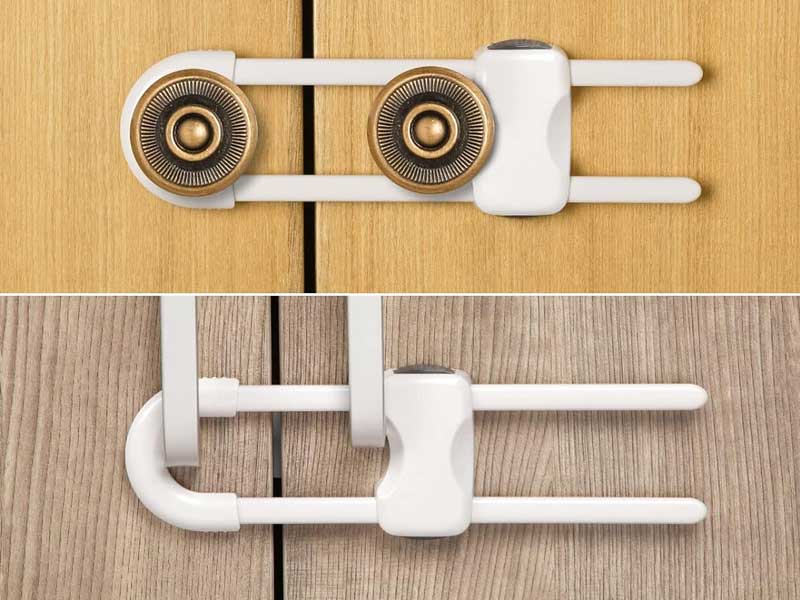
Childproof solutions often announce themselves visually. Bright straps. Bulky latches. Exposed hardware. While effective, these can disrupt the look of a space and create a constant reminder of restriction.
THAULANG’s drawer locks are designed to remain hidden from view once installed. When the drawer is closed, the lock is not visible from the outside. This supports a calmer environment, especially in shared living spaces where adults do not want safety measures to dominate the room’s appearance.
Invisible protection also reduces curiosity. Children are less likely to fixate on mechanisms they cannot see. Pets are less likely to paw or chew at hidden components.
In this sense, drawer safety becomes passive rather than confrontational.
Easy installation as a form of reliability
Complex installation often leads to errors. Errors weaken safety systems.
THAULANG’s design emphasizes a straightforward installation process that relies on surface preparation and precise placement rather than tools or permanent hardware. This simplicity reduces the chance of misalignment, uneven adhesion, or mechanical stress.
When installed correctly, the lock engages cleanly and releases predictably using the side hook. Adults retain full access without needing to remove or disable the system.
Ease of installation also supports consistency. When all drawers are secured using the same method, household rules remain clear and uniform.
Drawer safety without overcorrecting
Effective drawer safety is about proportional response. Not every drawer needs a heavy-duty lock. Not every household wants permanent hardware.
These childproof locks for drawers are designed for environments where the goal is controlled access rather than total restriction. Cleaning supplies. Utensils. Tools. Items that are safe for adults but inappropriate for unsupervised access.
By focusing on zero-gap prevention and strong adhesion, the locks address the specific risk of reaching and pulling, which is common among infants and toddlers.
This targeted approach avoids unnecessary escalation while still delivering meaningful protection.
Where these locks make the most sense
THAULANG’s system is well suited for drawers in kitchens, bathrooms, bedrooms, and storage areas where smooth drawer faces allow proper adhesion.
Common use cases include:
- Kitchen drawers holding utensils or tools
- Bathroom drawers with grooming or cleaning products
- Bedroom dressers accessible to young children
- Office drawers storing small items or cords
Because the locks are external and space-saving, they work well in drawers that are frequently accessed by adults throughout the day.
Understanding limitations clearly
No safety product works in every scenario. These locks require drawers to meet specific installation space requirements. Drawers that fall outside those dimensions cannot be secured properly with this system.
The adhesive also requires time to set. Immediate use after installation may compromise bond strength. This is not a flaw, but a characteristic of strong adhesive systems designed for long-term hold.
Seen in context, these limitations help define appropriate use rather than diminish value.
A calm approach to infant drawer locks
Infant drawer locks often fail not because they are weak, but because they are overdesigned or poorly matched to the environment. THAULANG’s solution avoids that trap by focusing on core mechanics: zero gap, strong hold, and invisible placement.
The result is a system that supports childproof drawer locks without adding daily friction for adults. It does not demand constant engagement. It simply enforces a boundary reliably.
For households seeking drawer safety that feels intentional rather than reactive, this design aligns well with real-world use.
Safety as part of ownership, not an interruption
For parents and caregivers, protecting a child often means preventing access before curiosity turns into risk. These safety drawer locks are built to hold that boundary quietly and consistently, keeping small hands away from drawers that should remain off-limits. With a zero-gap design, strong adhesive hold, and hidden placement, they protect without adding visual clutter or daily friction. Once in place, they work in the background, offering steady reassurance that a little one can explore safely within clear, dependable limits.
6 Pack Child Safety Drawer Locks – THAULANG Zero Gap Invisible Drawer Latches with Strong Adhesive
Available on Amazon

Leah writes about home safety from a practical, household-centered perspective. She pays close attention to how safety products are used in daily routines and how they contribute to a more secure living environment. Her work aims to help homeowners make thoughtful choices that improve safety without unnecessary complexity.