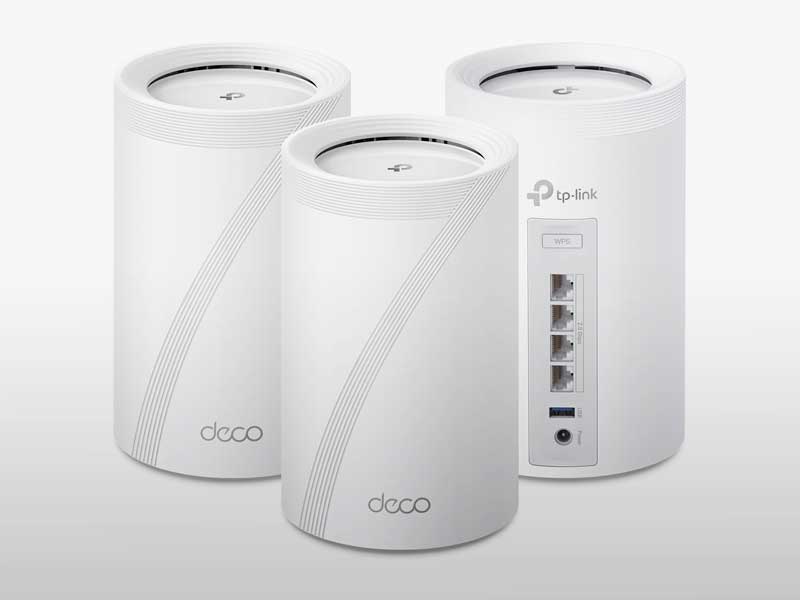

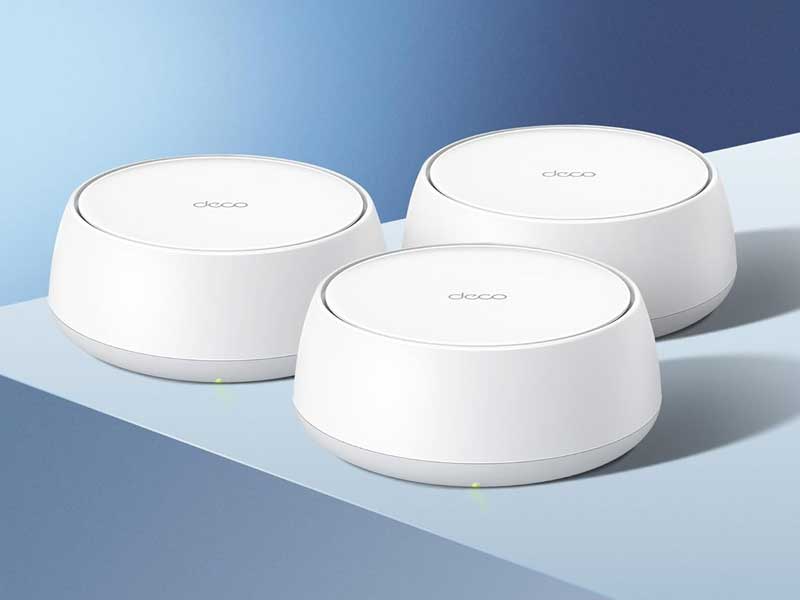
Most WiFi mesh instability isn’t caused by coverage gaps, but by how a system coordinates backhaul, roaming, and mixed-generation devices under load. That becomes more visible with WiFi 7, where features like Multi-Link Operation directly affect network consistency depending on how they are implemented. The TP-Link Deco 7 BE25 treats WiFi 7 as a mesh coordination layer, setting clearer expectations for reliability once the system is fully deployed across a home.
Where the Deco 7 BE25 Fits in a Modern Home Network
A WiFi 7 mesh system like the TP-Link Deco 7 BE25 is typically introduced into homes that already rely on a mix of wired devices, legacy WiFi clients, and newer high-throughput hardware. In that environment, raw peak speed is rarely the limiting factor. Stability depends more on how the mesh nodes distribute traffic, how quickly clients roam between units, and how well the system avoids bottlenecks when multiple devices compete for airtime.
The Deco 7 BE25 is positioned as a dual-band BE5000 system, offering up to 4324 Mbps on the 5 GHz band and 688 Mbps on the 2.4 GHz band through a four-stream configuration. These figures establish headroom rather than guaranteed throughput, which is an important distinction when evaluating long-term performance. In a mesh context, available capacity matters most when several devices are active simultaneously and when backhaul traffic shares spectrum with client traffic.
Coverage is rated for up to 6,600 square feet with the three-pack configuration. That figure assumes typical residential construction and appropriate node placement, but it also signals that the system is intended to scale across larger homes without requiring aggressive tuning. From an integration standpoint, this suggests a design focused on maintaining consistent signal strength and predictable roaming behavior rather than maximizing range from a single node.
WiFi 7 Features as System-Level Tools
Multi-Link Operation and traffic coordination
Multi-Link Operation is one of the defining features of WiFi 7, and in the Deco 7 BE25 it functions as a coordination mechanism rather than a performance toggle. By allowing compatible devices to utilize multiple links, MLO can reduce latency spikes and smooth traffic flow when conditions fluctuate. The benefit is not constant peak speed, but fewer interruptions when the network is under load.
In a mesh environment, this matters because each node must manage both client connections and inter-node communication. When MLO is implemented with mesh awareness, it helps distribute traffic more evenly across available resources. The result is a network that feels more consistent during everyday use, particularly when multiple devices are active in different parts of the home.
4K-QAM and Multi-RUs in practical use
Technologies like 4K-QAM and Multi-RUs further increase efficiency, but only when paired with compatible clients and favorable conditions. In practice, these features provide incremental gains rather than dramatic shifts. Their real value lies in improving spectrum utilization so that the system can handle more simultaneous connections without degrading overall responsiveness.
For households with a growing number of smart-home devices, sensors, and streaming endpoints, this efficiency translates into fewer slowdowns during peak usage. The Deco 7 BE25’s design suggests an emphasis on maintaining usable performance across many devices rather than optimizing for a single high-speed client.
Mesh Coverage and Device Density
Signal distribution across large spaces
The Deco 7 BE25 uses four high-gain antennas and four high-power FEMs per unit to extend coverage and maintain signal quality across rooms and floors. In a mesh system, antenna design influences not just range but also how cleanly nodes communicate with each other. Stable inter-node links are critical for maintaining throughput as clients move throughout the home.
The advertised support for over 150 devices reflects a focus on device density rather than just square footage. In smart homes, the cumulative effect of many low-bandwidth devices can strain poorly designed networks. A system that maintains consistent performance under that load reduces the need for manual segmentation or frequent troubleshooting.
Unified network behavior
Like other Deco systems, the Deco 7 BE25 operates under a single network name. This unified SSID is not merely a convenience feature; it is central to how roaming decisions are made. When nodes share state information effectively, clients can transition between access points with minimal disruption, which is particularly important for voice assistants, security cameras, and real-time applications.

TP-Link Deco 7 BE25 Dual-Band BE5000 WiFi 7 Mesh Wi-Fi System | 4-Stream 5 Gbps, 240 Mhz | Covers up to 6,600 Sq.Ft | 2X 2.5G Ports Wired Backhaul
Available on Amazon
Wired Backhaul and Physical Network Integration
Dual 2.5G ports per unit
Each Deco 7 BE25 unit includes two 2.5 Gbps WAN/LAN ports, which significantly affects how the system can be integrated into an existing network. These ports allow for high-speed wired connections to desktops, network-attached storage, or upstream switches without immediately saturating the link.
From a system design perspective, this also enables more flexible topology choices. Homes with existing Ethernet runs can offload backhaul traffic to wired connections, preserving wireless capacity for client devices. This approach often yields more predictable performance than relying solely on wireless backhaul.
Simultaneous wired and wireless backhaul
The Deco 7 BE25 supports simultaneous wired and wireless backhaul through TP-Link’s implementation combined with WiFi 7 MLO. This hybrid approach allows the mesh to adapt dynamically, maintaining connectivity even if one path becomes constrained. In practice, this reduces the risk of localized slowdowns caused by temporary interference or changes in network load.
Security and Network Management Considerations
Built-in security posture
TP-Link’s participation in the U.S. Cybersecurity and Infrastructure Security Agency’s Secure-by-Design pledge indicates a baseline commitment to secure development practices. While this does not eliminate the need for user awareness, it suggests that security considerations are integrated into the device lifecycle rather than added later.
The Deco 7 BE25 includes TP-Link HomeShield, which provides basic network security features such as security scans and IoT device identification at no additional cost. These tools are intended to improve visibility rather than replace dedicated security appliances, helping users understand what is connected and whether obvious vulnerabilities are present.
Parental controls and QoS
Basic parental controls and Quality of Service features are included as part of the free HomeShield offering. From a systems standpoint, QoS is particularly relevant in mixed-use households, where work, streaming, and automation traffic compete for bandwidth. Properly applied, it helps maintain responsiveness for latency-sensitive applications without manual intervention.
VPN Support and Remote Access
Centralized VPN handling
The Deco 7 BE25 supports both VPN clients and server functionality, enabling devices on the network to access remote VPN services without installing software individually. This centralized approach simplifies management and ensures consistent behavior across devices.
Simultaneous VPN and regular internet connections are supported, which allows specific traffic to be routed securely without forcing all devices through the VPN tunnel. In practical terms, this flexibility makes it easier to integrate secure remote access into a household network without disrupting everyday connectivity.
Compatibility Within Broader Ecosystems
Backward compatibility and ISP flexibility
The Deco 7 BE25 is backward compatible with all previous WiFi generations, which is essential in real-world deployments where device refresh cycles vary. Older laptops, smart TVs, and IoT devices can coexist with newer WiFi 7 clients without requiring separate networks.
Compatibility with any internet service provider further simplifies deployment. While a modem is required for most ISPs, the Deco system itself does not impose restrictions based on provider, allowing it to be integrated into a wide range of broadband environments.
Expansion with other Deco units
TP-Link Deco products are designed to work together, allowing users to expand coverage by adding compatible units. This modularity supports gradual scaling rather than requiring a full system replacement when coverage needs change. From a long-term perspective, this approach aligns with maintaining system coherence over time.
Voice Control and Everyday Interaction
Voice control via Amazon Alexa or Google Assistant-enabled devices provides an additional layer of convenience for basic network management tasks. While voice commands are not central to network performance, they can simplify routine interactions such as enabling guest networks or checking system status.
In a smart-home context, this integration supports a consistent control paradigm, reducing friction for users who already rely on voice assistants for other devices.
Reliability Over Time
Evaluating a WiFi 7 mesh system ultimately comes down to how it behaves after the initial setup period. The Deco 7 BE25’s combination of mesh coordination features, wired backhaul options, and backward compatibility suggests a system designed to remain stable as device counts increase and usage patterns evolve.
Rather than emphasizing transient performance gains, its design choices point toward maintaining consistent connectivity across rooms and devices. For households where the network underpins security systems, automation routines, and daily work, that consistency is often the most meaningful measure of quality.
Assessing Long-Term Stability and System Fit
The TP-Link Deco 7 BE25 WiFi 7 mesh system is best understood as a coordinated networking platform rather than a collection of isolated features. Its approach to WiFi 7 focuses on how traffic is managed, how nodes cooperate, and how the system adapts to real-world conditions over time. For users seeking a WiFi 7 mesh system that prioritizes predictable behavior, compatibility, and long-term reliability within a broader smart-home environment, the Deco 7 BE25 sets expectations that align with how home networks are actually used.
TP-Link Deco 7 BE25 Dual-Band BE5000 WiFi 7 Mesh Wi-Fi System | 4-Stream 5 Gbps, 240 Mhz | Covers up to 6,600 Sq.Ft | 2X 2.5G Ports Wired Backhaul
Available on Amazon

Vince is a smart-home systems installer with extensive experience setting up security devices, automation hubs, and connected home ecosystems. He understands integration challenges, performance issues, and what truly improves daily living. Vince writes practical guides that help readers build reliable and user-friendly smart-home setups.