
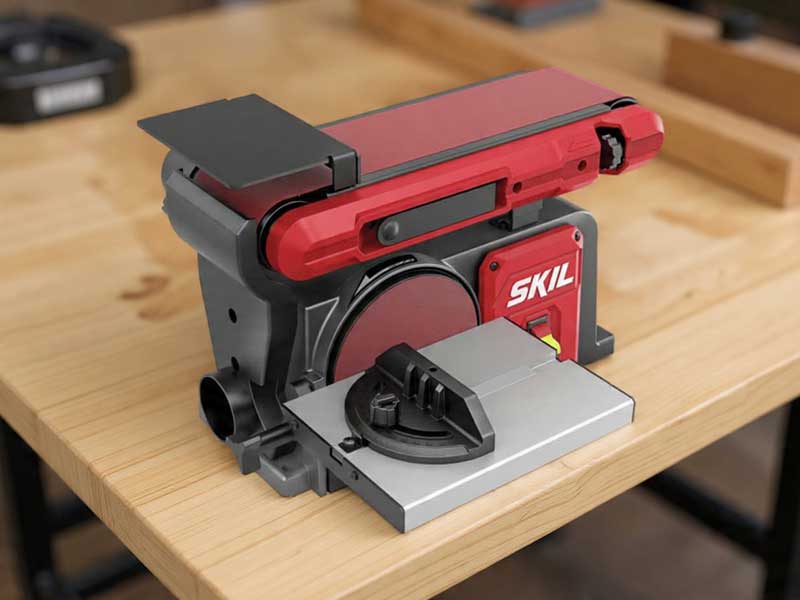
When beginners start looking for a sanding setup, the confusion usually isn’t about whether sanding matters—it’s about which type of sander actually fits a home workspace. Handheld sanders feel familiar, but they don’t always offer control. Larger shop machines look capable, but they can feel excessive. This is where a benchtop belt and disc sander often enters the conversation, especially models like the SKIL 4.5 Amp Belt and Disc Combination Benchtop Sander BB9504-00, which aim to balance versatility, size, and approachability for DIY users who want predictable results without overcomplicating the process.
Rather than treating sanding as a mysterious skill, it helps to understand how a machine like this is designed to work—and what those design choices actually mean for common home projects.
What a Benchtop Belt and Disc Sander Is Designed to Do
A benchtop belt and disc sander is essentially a fixed sanding station. Instead of moving the tool across the material, the material is guided against controlled sanding surfaces. This design reduces variability, which is often what frustrates newer DIYers.
The SKIL BB9504-00 is a two-in-one sanding station, combining a belt sander and a disc sander in a single benchtop footprint. That combination is important because it covers two different sanding behaviors without requiring separate machines.
A benchtop sander like this typically appeals to DIYers working with wood pieces that need shaping, smoothing, or edge refinement rather than surface-wide material removal.
Understanding the Two-in-One Sanding Station Concept
Belt sanding for length and edge control
The belt component is designed for sanding longer edges and flatter surfaces. Because the sanding belt moves in a continuous loop, it supports consistent contact along the length of a workpiece. For a DIY user, this consistency matters more than speed or aggressiveness.
With the SKIL benchtop sander, the belt angle adjustment allows the belt to be positioned anywhere from 0 to 90 degrees. This flexibility supports different sanding orientations depending on how a workpiece needs to be presented, without forcing awkward hand positioning.
Disc sanding for angles and end grain
The disc sander serves a different purpose. It provides a flat, circular sanding surface that’s particularly useful for shaping ends, corners, and angled cuts. Disc sanding tends to offer more predictable geometry, especially when paired with a guide.
Having both sanding styles in one woodworking sander allows users to choose the surface that best matches the task instead of adapting the task to the tool.
Why the Motor Type Matters More Than Raw Power
Induction motor consistency
The SKIL BB9504-00 uses a 4.5 amp induction motor, which is a notable design choice for a benchtop belt and disc sander. Induction motors are typically valued for their steady operation rather than peak output.
For a typical DIY user, consistent sanding pressure is more useful than maximum force. A steady motor helps maintain even material removal, which reduces the chance of gouging or uneven edges.
Translating amps into practical expectations
Amperage ratings often cause confusion. A 4.5 amp motor doesn’t automatically mean “heavy-duty,” but it does indicate the machine is built to handle sustained operation within its intended scope. In this case, that scope aligns with woodworking and general DIY sanding tasks rather than industrial workloads.
Belt Angle Adjustment and Why It’s Not Just a Convenience Feature
Changing orientation without changing technique
The ability to adjust the belt angle from horizontal to vertical isn’t about adding complexity—it’s about reducing it. Different sanding orientations allow the user to keep the workpiece stable and visible rather than forcing uncomfortable hand positions.
For beginners, visibility is an underrated advantage. Being able to clearly see how material contacts the sanding belt makes it easier to understand what’s happening and correct technique naturally.
Supporting varied project types
Whether sanding a long edge, flattening a small surface, or refining a corner, angle adjustment allows the same benchtop sander to adapt without extra accessories. This flexibility contributes to the overall value of a combination belt and disc sander.

SKIL 4.5 Amp Belt and Disc Combination Benchtop Sander – BB9504-00
Available on Amazon
How the Miter Gauge Adds Predictability
Guiding rather than guessing
The included miter gauge helps guide workpieces during crosscuts and angled sanding on the disc. Instead of relying on freehand alignment, the gauge introduces a reference point.
This is especially helpful for DIYers who want repeatable angles without advanced measuring tools. The miter gauge doesn’t replace careful setup, but it reduces guesswork, which builds confidence.
Learning geometry through use
Using a guide also reinforces how angles interact with sanding surfaces. Over time, this helps users better understand how sanding affects shape—not through theory, but through visual feedback.
The Beveling Tabletop and Angle Control
Adjustability from 0 to 45 degrees
The beveling tabletop on the SKIL BB9504-00 allows sanding at angles between 0 and 45 degrees. This feature supports tasks like chamfering edges or refining angled joints.
Rather than forcing angled sanding to be done by hand, the adjustable table creates a stable reference plane. Stability is one of the most important factors in achieving clean results, especially for newer DIYers.
Why controlled angles reduce rework
Inconsistent angles often lead to extra sanding to “fix” mistakes. A fixed bevel angle helps reduce that cycle, making projects feel more manageable and predictable.
Quick Tension Release and Sandpaper Changes
Reducing friction in the workflow
Changing sandpaper grits is a normal part of sanding, but complicated tension systems can discourage users from switching when they should. The quick tension release lever simplifies this process.
When grit changes feel easy, users are more likely to use appropriate grits for each stage rather than pushing one belt too far.
Encouraging better sanding habits
Good sanding isn’t about force—it’s about progression. A simple tension release supports that learning curve by removing unnecessary obstacles.
Dust Management and the Realities of Small Workshops
The role of a dust port
The built-in dust port accepts standard 2 ½-inch vacuum hoses. While no benchtop sander eliminates dust entirely, having a connection point helps manage accumulation at the source.
For home workshops, dust control is less about perfection and more about maintaining visibility and cleanliness during a project.
Why dust collection affects accuracy
Reduced dust buildup helps keep sanding surfaces visible and prevents debris from interfering with contact. This directly impacts how accurately material is shaped.
Mounting the Sander for Stability
Pre-drilled mounting holes explained
The SKIL benchtop sander includes pre-drilled holes in the base for mounting to a workbench. This isn’t just a safety feature—it’s a performance feature.
A mounted sanding station resists vibration and movement, which helps maintain consistent contact between the workpiece and sanding surface.
Stability builds confidence
For beginners especially, a stable tool encourages slower, more controlled movements. This reduces mistakes and reinforces good technique without conscious effort.
Evaluating Value for DIY Users
A benchtop belt and disc sander isn’t about replacing every sanding tool—it’s about creating a reliable sanding reference point. The SKIL 4.5 Amp Belt and Disc Combination Benchtop Sander BB9504-00 focuses on practical design choices that support learning, consistency, and adaptability.
Features like the induction motor, adjustable belt angle, miter gauge, beveling tabletop, and dust port work together to create a balanced woodworking sander that fits comfortably into a home workshop. Rather than chasing extremes, the design emphasizes usability and clarity.
Is This Benchtop Belt and Disc Sander a Good Fit?
For DIYers looking to move beyond handheld sanding without committing to large shop equipment, a benchtop belt and disc sander offers a middle ground. The SKIL BB9504-00 supports a range of sanding tasks while keeping controls understandable and features purposeful.
Understanding how the machine works—and why each feature exists—makes choosing a tool feel less intimidating. When a sanding station supports learning as much as results, it becomes easier to approach projects with calm confidence rather than hesitation.
SKIL 4.5 Amp Belt and Disc Combination Benchtop Sander – BB9504-00
Available on Amazon

Jenna is a mechanical engineering graduate who fell in love with weekend DIY projects during college. She enjoys analyzing how tools are built, how they perform, and whether they offer real value. Jenna writes in a friendly, accessible style that helps beginners feel confident tackling their first home upgrades.