
In many households, the wok isn’t an everyday star. It comes out when meals shift from predictable to a little more expressive—weeknight stir-fries, leftover transformations, or weekend cooking that needs space and heat without feeling fussy. What people often want in those moments is not mastery, but control: a pan that behaves predictably, cleans without ceremony, and fits back into the cabinet without demanding special treatment.
That’s where a modern hybrid wok begins to make sense. The HexClad Hybrid Nonstick 12-Inch Wok isn’t trying to replace traditional cookware or redefine technique. It exists for households that want flexibility—something that can move between cooking styles, appliances, and routines without becoming a project to own.
Why a Hybrid Wok Exists in Real Kitchens
Most home cooks aren’t choosing between stainless steel or nonstick in isolation. They’re responding to friction they’ve already felt: food sticking when heat gets high, coatings that feel delicate, pans that heat unevenly or limit utensil choices. Hybrid cookware is a response to that middle ground, where daily cooking habits don’t neatly align with one material philosophy.
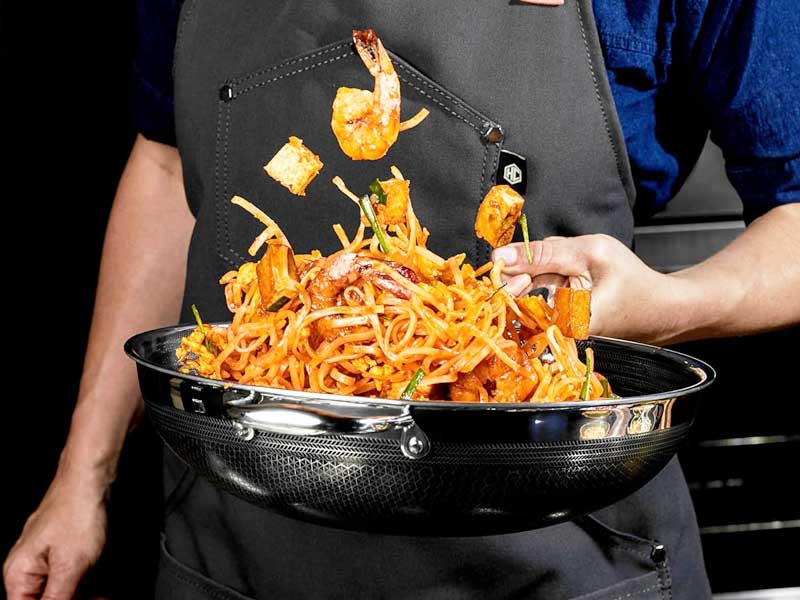
HexClad’s approach combines a laser-etched hexagonal surface that exposes stainless steel peaks alongside a ceramic-based nonstick layer. In practical terms, this means the pan can tolerate higher heat and metal utensils while still releasing food more easily than traditional stainless alone. It’s not about perfection in one direction, but balance that suits varied meals and shared kitchens.
A Shape Designed for Movement, Not Performance Theater
The 12-inch wok size and Northern-style profile are less about spectacle and more about control. A wider opening gives food room to move without crowding, which matters even when cooking modest portions for a household rather than restaurant volumes.
The long stainless stay-cool handle supports steady one-handed movement, while the helper handle acknowledges a reality many pans ignore: lifting a loaded wok often requires two hands. That small design decision tends to matter over time, especially when the pan is used across different cooking strengths within the same household.
Heat Behavior That Feels Predictable Over Time
Tri-ply construction with an aluminum core is one of those features that’s easy to overlook until it’s missing. Even heating isn’t about speed for its own sake; it’s about reducing guesswork. When heat distributes consistently across the cooking surface, recipes become more forgiving, and improvisation feels safer.
This construction also explains why the wok works across all cooktops, including induction. For homes with mixed appliances—or those anticipating a future kitchen upgrade—this compatibility removes a common ownership anxiety. The pan doesn’t dictate the kitchen; it adapts to it.
Because the wok is oven-safe up to 900°F, it can move between stovetop and oven without forcing a mental reset. That flexibility tends to matter most not in ambitious cooking, but in ordinary meals that evolve mid-process. The ability to finish, hold, or adjust without switching cookware quietly supports calmer cooking decisions.

HexClad Hybrid Nonstick 12-Inch Wok, Stay-Cool Handle, Dishwasher-Friendly, Oven-Safe Up to 900°F, Induction Ready, Compatible with All Cooktops
Available on Amazon
Living With a Nonstick Surface That Isn’t Precious
Many nonstick pans come with an unspoken rulebook: no metal utensils, careful washing, cautious heat. Over time, that caution can discourage use. HexClad’s hybrid surface shifts that dynamic by being metal utensil-safe and dishwasher-friendly, which aligns more closely with how people actually treat everyday cookware.
This doesn’t mean care disappears, but it becomes more intuitive. Cleanup feels routine rather than corrective, and the pan doesn’t need to be mentally “saved” for certain foods or days. For households where multiple people cook—or where cooking happens at different energy levels—this kind of resilience supports consistency.
The ceramic-based nonstick layer is also positioned as part of a long-term ownership mindset. Instead of expecting the surface to remain flawless forever, the design prioritizes durability and usability across years of varied use, which tends to match how cookware earns its place in a cabinet.
Ownership Details That Matter Later, Not First
The wok weighs about three pounds, a middle ground that feels manageable without feeling insubstantial. It’s heavy enough to stay planted on the cooktop, yet light enough to move confidently when full. Those qualities often register gradually, becoming noticeable only when switching back to less cooperative pans.
It’s also worth noting that this 12-inch wok does not include a lid. In context, that’s less a drawback than a signal of intended use. This pan is built for open, active cooking rather than sealed steaming, and many households already own compatible lids. Understanding that upfront helps align expectations with how the wok naturally fits into existing cookware collections.
Long-Term Confidence Without Overpromising
HexClad backs this wok with a lifetime warranty covering manufacturer’s defects for home use, which frames the product as something meant to stay in rotation rather than cycle out. That assurance doesn’t change daily cooking, but it does influence how comfortable people feel committing to a higher-quality pan.
Over time, cookware earns trust through reliability, not novelty. A wok that heats evenly, tolerates real utensils, cleans without friction, and works across appliances tends to become a default choice rather than a specialty tool. That’s ultimately where the HexClad Hybrid Nonstick 12-Inch Wok positions itself: not as an upgrade for cooking ambitions, but as a steady companion for everyday meals that occasionally ask for more room, more heat, and less worry.
HexClad Hybrid Nonstick 12-Inch Wok, Stay-Cool Handle, Dishwasher-Friendly, Oven-Safe Up to 900°F, Induction Ready, Compatible with All Cooktops
Available on Amazon

Emily trained in culinary school and worked in several fast-paced restaurant kitchens before shifting into product testing. She understands how cookware, knives, and prep tools should perform under pressure. Emily’s reviews blend professional cooking standards with relatable insights for home chefs looking to upgrade their daily tools.