
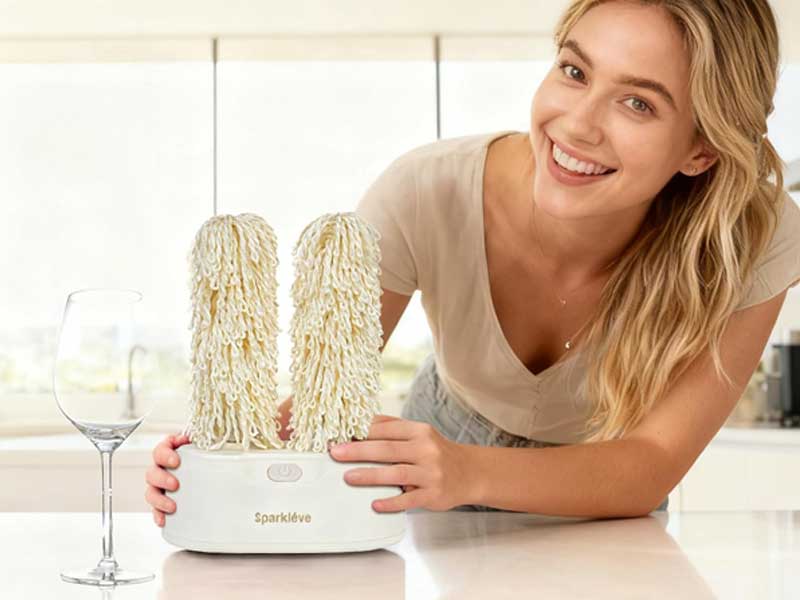
It’s easy to assume that spotless glassware is simply a matter of rinsing, drying, or running a dishwasher cycle. Yet even careful routines often leave streaks, smudges, or faint water spots that catch the eye at the worst moment—like during a dinner party or casual gathering. The Home Glassware Polisher, spinning at 600 RPM, offers a methodical approach that eliminates these inconsistencies, gently drying and polishing every glass for a uniform, clear finish without relying on trial-and-error buffing.
Imagine preparing for a small dinner at home. You’ve washed a set of wine glasses, but the subtle haze and fingerprints still show. Reaching for a cloth, you notice streaks or lint left behind, and the process quickly becomes tedious. The spinning polisher handles this stage automatically, giving predictable results that free up both time and attention for other preparations.
How the Spinning Glass Polisher Works for Everyday Use
At the heart of the polisher’s design is the dual-brush system. One set of brushes contacts the interior surface of the glass, while the other addresses the exterior. This simultaneous cleaning and drying ensures that water spots and streaks are minimized, something difficult to achieve with a single cloth or hand-polishing routine. The soft microfiber bristles are absorbent enough to handle residual water yet gentle enough to avoid scratching delicate rims.
The motor’s 600 RPM rotation is calibrated to optimize both speed and safety. Faster rotations might risk delicate glass edges, while slower spins could make polishing time-consuming. This speed provides steady, controlled results for wine glasses, champagne flutes, tumblers, water bottles, and most common barware. The suction-cup base stabilizes the device on smooth surfaces, preventing wobble and reducing the risk of accidental tipping during operation.
Another advantage is the device’s quiet motor. Many spinning tools produce noticeable noise, which can be distracting in a kitchen or bar setting. Here, the Home Glassware Polisher balances power and discretion, making it practical for everyday use without adding unnecessary disruption.
Microfiber Brushes and Replacement Cycles
The polishing brushes are designed to last through thousands of spins, and they are dishwasher-safe for simple cleanup. Over time, worn brushes can affect polishing performance, but replaceable pads make this process straightforward and cost-effective. The included polishing cloth allows for final handling without smudges, maintaining the clarity achieved by the spinning process.
Unlike standard cleaning cloths that can wear unevenly or accumulate lint, these microfiber brushes maintain consistent absorption and surface contact. Over repeated use, this reliability becomes a clear advantage for households that rely on precise presentation.
Benefits Over Manual Glass Cleaning
Manual polishing involves multiple steps: washing, drying, and then hand-polishing with cloths or towels. While effective with careful technique, it often introduces inconsistencies:
- Water spots: Even minor mineral deposits can create streaks.
- Dishwasher haze: Hard water or detergent residue may leave dull surfaces.
- Fingerprints and lipstick: Standard cloths may smear rather than remove marks.
The spinning glass polisher addresses these issues systematically. It dries and polishes simultaneously, absorbs residual water, and reaches both inside and outside surfaces. This makes it particularly useful for entertaining, where uniform clarity across multiple glasses matters.
In practice, this system can reduce polishing time by more than half compared to manual methods, depending on glass type and quantity. The consistency across different glass shapes—stemware, tumblers, and even reusable bottles—demonstrates practical efficiency that’s difficult to replicate with a standard cloth.
Real-World Glassware Scenarios
- Dinner parties: A quick spin before guests arrive removes subtle streaks and fingerprints.
- Daily household use: Water bottles and drinking glasses come out polished, reducing daily maintenance.
- Bar setups: Champagne flutes, cocktail glasses, and wine glasses are uniformly ready for presentation.
This versatility ensures the polisher is not just a luxury device but a practical tool for everyday situations.
Durability and Longevity Considerations
Long-term reliability is a major factor when evaluating cleaning tools. The Home Glassware Polisher balances mechanical durability with user-friendly maintenance. The motor is engineered for frequent operation without overheating, while the suction-cup base remains stable even after repeated use.
Brush longevity is another practical consideration. Each brush withstands thousands of spins, and replacement is straightforward. For households that clean multiple sets of glassware regularly, this ensures predictable performance over months or years without the need for frequent device maintenance.
Even the included polishing cloth contributes to long-term value. By allowing secure handling post-spin, it reduces the risk of new fingerprints or streaks, maintaining the polished results consistently.
Tips for Optimal Results
For best performance, some practical steps help maximize efficiency:
- Pre-clean glasses: Remove sticky residue or heavy stains before spinning.
- Position carefully: Ensure glasses sit centered to avoid wobble or uneven contact.
- Use included cloth: After spinning, handle glasses with the microfiber cloth to maintain clarity.
- Regular brush checks: Inspect and replace brushes when fibers wear down to ensure uniform polishing.
Understanding these minor adjustments ensures the polisher delivers consistent, streak-free results.

Home Glassware Polisher, World’s First Affordable Spinning Glass Polisher, 600 RPM Dries & Polishes, All Glasses, Wine, Bar, Drinking, Wet/Dry
Available on Amazon
Comparing Traditional vs. Automated Glass Polishing
It helps to see how manual methods compare with the spinning approach:
| Method | Time | Consistency | Surface Care | Practical Notes |
| Hand Polishing | High | Variable | Risk of scratches | Labor-intensive, streaks possible |
| Dishwasher Only | Medium | Moderate | Residue and haze possible | Convenient but often leaves spots |
| Home Glassware Polisher | Low | High | Gentle, uniform | Efficient, reduces manual effort |
While the polisher does not eliminate washing, it provides a controlled finishing step that traditional methods often lack, especially when multiple glasses are involved.
Noise, Space, and Usability
Many kitchen appliances create minor inconveniences that accumulate over time. The polisher’s quiet motor is subtle enough to operate alongside other activities, while the suction base stabilizes the device without requiring bulky attachments. Its footprint is compact enough for countertop or bar use, making it practical for kitchens of various sizes.
Limitations and Realistic Expectations
No tool is universally perfect. Extremely thin or unusually shaped glasses require careful placement to avoid imbalance during spinning. Additionally, deeply set stains may need prior cleaning with a standard solution. The device excels at removing water spots, streaks, and light residues, but it cannot replace comprehensive pre-cleaning when glasses are heavily soiled.
Accepting these limitations allows homeowners to use the polisher with confidence, without unrealistic expectations or frustration.
Efficiency Gains in Busy Homes
Time savings become especially noticeable when cleaning multiple glasses. A quick spin before serving eliminates small imperfections that would otherwise require detailed hand polishing. For households hosting guests regularly, this efficiency is not just convenient—it preserves a professional-looking presentation without extra effort.
Even on ordinary days, the spinning process minimizes the repetitive finishing step, making polished glassware a consistent, low-effort routine rather than a chore.
Final Thoughts on the Home Glassware Polisher
The Home Glassware Polisher demonstrates how thoughtful engineering can simplify a repetitive household task. Its dual brushes, 600 RPM spinning motor, quiet operation, and durable microfiber pads provide reliable results for a wide variety of glassware. While it does not replace initial washing or handle extremely stubborn stains alone, it streamlines polishing and drying in a way that manual methods rarely match.
For homeowners seeking predictability and consistency, this polisher delivers practical value. It turns the often tedious final step of cleaning into a straightforward, repeatable process. Every glass emerges polished, streak-free, and ready to serve, giving confidence in presentation without added stress or labor.
Home Glassware Polisher, World’s First Affordable Spinning Glass Polisher, 600 RPM Dries & Polishes, All Glasses, Wine, Bar, Drinking, Wet/Dry
Available on Amazon

Kyle worked as a janitorial team leader in a corporate office setting, where he became familiar with heavy-duty cleaning equipment. He now focuses on translating that expertise into helpful product insights for homeowners. Kyle’s reviews highlight durability, ease of use, and effectiveness in real-life cleaning scenarios.