
Smart-home security is often framed as a choice between flexibility and seriousness—either you accept a rigid, contract-heavy system, or you settle for something lightweight that feels less dependable. That assumption oversimplifies what many newer systems actually offer. The SimpliSafe wireless home security system sits in the middle of that conversation, combining app-based control and optional professional monitoring in a way that’s designed to adapt to everyday living rather than dictate it.
What the SimpliSafe Wireless Home Security System Is Designed to Do
At its core, the SimpliSafe wireless home security system is built around approachability. This eight-piece kit is meant to cover the fundamentals of home protection without requiring structural changes, technical expertise, or long-term commitments. For many households, especially renters or first-time smart-home users, that positioning matters more than an exhaustive feature list.
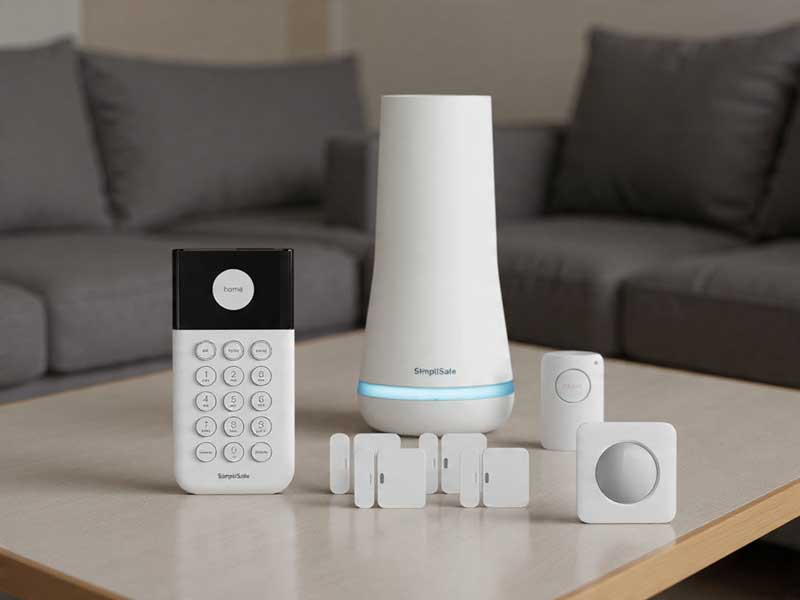
The system centers on a Base Station that acts as the hub for sensors, alerts, and connectivity. From there, door and window entry sensors, a motion sensor, a keypad, and a panic button form a basic but flexible security layout. The emphasis is not on custom wiring or permanent installation, but on modular placement that can change as living arrangements change.
SimpliSafe also frames monitoring as optional rather than mandatory. Professional monitoring can be added starting at less than a dollar per day, but the system remains usable without it. That distinction quietly reshapes how the product fits into household budgeting and long-term planning.
Understanding What Comes in the 8-Piece System
The value of a security system often depends on how well its components work together, not just how advanced each piece is individually. In this kit, the components are selected to address common entry points and shared living spaces.
Entry Sensors and How They Fit Into Daily Routines
Entry sensors are designed for doors, windows, and even cabinets. They trigger alerts when opened and can be customized through the app, including the option for Secret Alerts that notify the user silently. This feature is often overlooked, but it adds nuance to how security functions day to day—especially in homes where privacy matters as much as intrusion prevention.
Rather than treating every opening as a threat, the system allows users to decide which interactions should be quietly logged and which should escalate into alarms. That flexibility reflects a more realistic understanding of how people move through their homes.
Motion Detection Without Constant Disruption
The motion sensor included in the system covers up to 35 feet with a 90-degree field of view. It’s designed to be placed in a corner for broader coverage and is calibrated to work with pets under 60 pounds. While no motion sensor is entirely immune to false triggers, this specification signals an effort to balance sensitivity with everyday household activity.
For families with pets, this consideration can significantly affect whether a system feels usable or frustrating over time. Motion detection becomes a background safeguard rather than a constant source of alerts.
Keypad and Panic Button as Control Layers
The wireless keypad provides an alternative to app-based control, with backlit buttons that appear only when needed. Its smash-safe design suggests durability, but its real role is accessibility. Not everyone wants to rely on a phone for basic actions like arming or disarming a system.
The panic button adds another layer of immediacy. When paired with professional monitoring, it can silently or audibly trigger emergency response. It’s a small device, but it shifts the system from passive monitoring to active intervention when needed.
Setup Philosophy and Why It Matters
One of the defining characteristics of this home security system is its setup approach. SimpliSafe emphasizes that the system can be installed without wiring or drilling, relying instead on placement and pairing through the SimpliSafe App.
This matters less for technical reasons and more for psychological ones. Systems that feel permanent often create hesitation—especially for renters or people planning future moves. A wireless security system that can be repositioned lowers the barrier to entry and reduces the sense of long-term obligation.
The app functions as the control center, allowing users to arm, disarm, and monitor their system remotely. While app reliability ultimately depends on network conditions, centralized control simplifies how the system integrates into daily routines rather than competing with them.
Monitoring Options and the Role of Choice
Professional monitoring is often treated as a default requirement in the security industry. SimpliSafe takes a different approach by making it optional and contract-free.
With monitoring enabled, trained agents can alert emergency responders when alarms are triggered. The Base Station supports cellular backup and a battery that lasts up to 24 hours, helping maintain protection during power outages or Wi-Fi disruptions. These features only activate fully with a monitoring plan, but the distinction is clearly defined.
What’s notable here is not just the presence of monitoring, but the absence of pressure. Users can start with self-monitoring and add professional services later, or use monitoring temporarily. This flexibility aligns with how people’s security needs evolve over time.

SimpliSafe 8 Piece Wireless Home Security System – Optional 24/7 Professional Monitoring – No Contract
Available on Amazon
Smart Home Compatibility in a Practical Context
Smart-home compatibility often sounds more impressive than it feels in everyday use. In this case, compatibility with Amazon Alexa and Google Assistant allows users to arm the system using voice commands at home.
This integration doesn’t turn the system into a broader home automation hub, and it doesn’t try to. Instead, it adds convenience to a specific action—arming the system—without introducing complexity. For households already using voice assistants, this feature feels additive rather than intrusive.
It’s a subtle example of smart home security done with restraint. The system integrates where it makes sense and stops short of overextending into areas that could complicate reliability.
Reliability Considerations Beyond the Headline Features
Security systems are often evaluated on what they promise, but reliability is shaped by what happens when conditions are less than ideal. The Base Station’s cellular backup and internal battery are designed to maintain basic functionality during outages, assuming a professional monitoring plan is active.
This doesn’t make the system invulnerable, but it does acknowledge common points of failure. Power and internet disruptions are not edge cases; they’re realistic scenarios. By planning for them, the system positions itself as a dependable layer rather than a fragile one.
The keypad’s durability and the wireless nature of the sensors also reduce reliance on any single physical connection. In combination, these elements contribute to a sense of continuity rather than perfection.
How This System Fits Different Household Types
No single home security system is universally ideal, but patterns emerge when looking at how products align with different living situations.
Apartments and Rental Homes
For renters, the lack of drilling and wiring is more than a convenience—it’s often a requirement. The ability to remove and reposition sensors without damage makes this wireless security system particularly suited to temporary or transitional living spaces.
Small to Medium-Sized Homes
The eight-piece configuration is designed to cover key entry points and a main living area. While larger homes may require additional sensors, the base kit provides a clear starting framework without overwhelming first-time users.
Households New to Smart Home Security
For those exploring smart home security for the first time, clarity matters. The SimpliSafe app, modular components, and optional monitoring help demystify the category. Instead of forcing users to understand everything at once, the system allows learning through gradual use.
Limitations Worth Understanding
A balanced view includes acknowledging where the system may not align with every expectation. Professional monitoring, cellular backup, and certain emergency features require a subscription. While this is clearly stated, it’s an important consideration for anyone comparing long-term costs.
Additionally, SimpliSafe products and monitoring services are only offered and supported in the United States. International users or those planning moves abroad would need to factor that limitation into their decision-making.
Finally, while the system integrates with major voice assistants, it doesn’t aim to replace a full smart-home ecosystem. Users looking for deep automation across lighting, climate, and security may see this as a focused rather than expansive solution.
Seeing the System as a Long-Term Choice
What distinguishes the SimpliSafe wireless home security system is not any single feature, but how its elements work together over time. The combination of modular hardware, app-based control, optional monitoring, and smart assistant compatibility creates a system that adapts to changing needs rather than locking users into a fixed model.
This adaptability is often undervalued in security discussions, yet it’s central to how people actually live. Homes change, routines shift, and priorities evolve. A system that acknowledges that reality can feel more reassuring than one that promises absolute control.
Where This Kind of Security Fits in Real Homes
The SimpliSafe wireless home security system is best understood as a flexible framework rather than a definitive answer to home security. It offers structure without rigidity, protection without contracts, and smart features without unnecessary complexity. For households looking to understand smart home security in practical terms—and to adopt it at their own pace—it provides a calm, well-considered entry point that emphasizes understanding over urgency.
SimpliSafe 8 Piece Wireless Home Security System – Optional 24/7 Professional Monitoring – No Contract
Available on Amazon

Lauren is a consumer tech writer who focuses on smart-home topics such as connected devices, home automation, and everyday IoT products. Instead of hands-on testing, she researches product features, user feedback, and long-term trends to produce clear, approachable articles. Lauren enjoys translating technical information into practical advice that readers can trust.